Search is changing. For years, businesses focused mainly on traditional Search Engine Optimisation (SEO) to help their websites appear in Google’s search results. Today, people are also using AI-powered search experiences where Generative Engine Optimization plays a critical role to find information, compare businesses, ask questions, and discover products and services.
This has introduced a new term into digital marketing: GEO, or Generative Engine Optimization.
GEO is generally used to describe strategies intended to improve the likelihood that a business, website, or piece of content will be found, understood, referenced, or mentioned by generative AI systems when they create answers to users’ questions. The term originated in academic research on generative search systems and has since become widely discussed in the SEO industry.
But Generative Engine Optimization does not mean that traditional SEO is dead. In fact, Google says its generative AI search features continue to rely on its existing Search ranking and quality systems, so established SEO practices remain relevant alongside Generative Engine Optimization.
So, what exactly is Generative Engine Optimization, how is it different from SEO, and what should businesses do about Generative Engine Optimization?
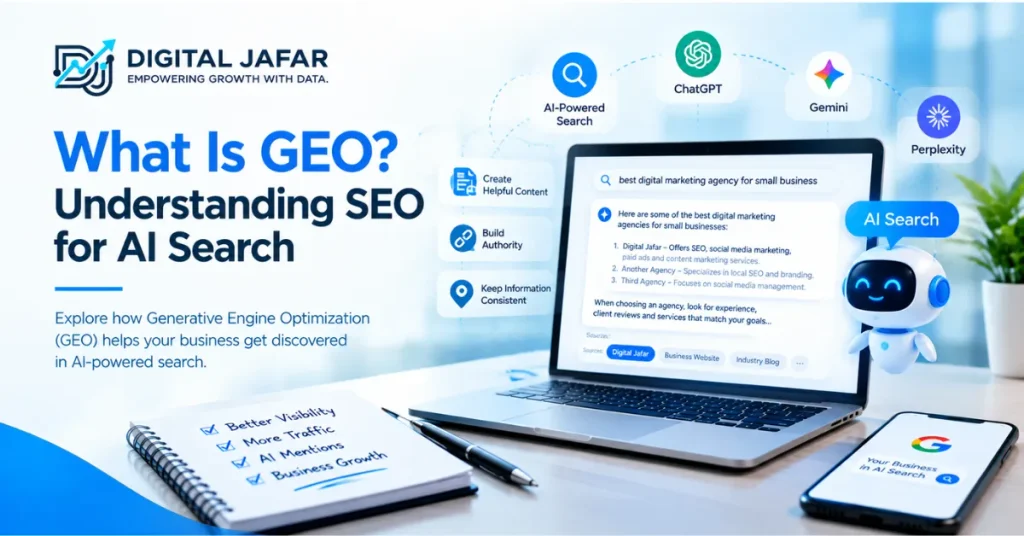
What Is GEO?
Generative Engine Optimization (GEO) is the practice of creating and structuring online information so that generative AI systems can more easily understand, retrieve, summarize, and potentially reference it in their responses.
Traditional search generally presents users with a list of links. Generative AI search using Generative Engine Optimization principles can instead combine information from multiple sources and produce a conversational answer.
For example, instead of searching:
“Best digital marketing services for a small business”
a user might ask an AI search system:
“What digital marketing services should a small business invest in, and why?”
The system may produce a detailed answer and potentially reference information from websites, articles, business sources, and other online content.
This creates a new opportunity for businesses through Generative Engine Optimization: being present in the information AI systems use to answer questions.
GEO vs SEO: What’s the Difference?
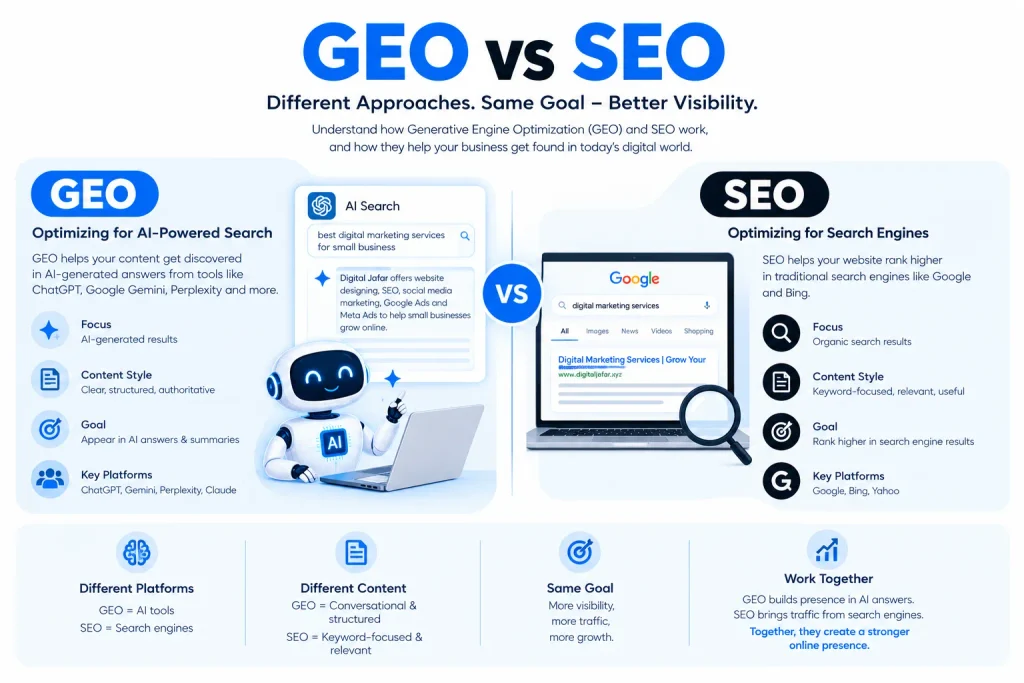
SEO and Generative Engine Optimization are closely connected, but their objectives are slightly different.
SEO focuses primarily on improving a website’s visibility in traditional search experiences.
Generative Engine Optimization focuses on improving the chances of a business or its content being represented or referenced in AI-generated answers.
For example, traditional SEO might focus on helping a page rank for:
“SEO services for small businesses”
Generative Engine Optimization may also consider questions such as:
“What should a small business look for when choosing an SEO agency?”
The two approaches overlap because AI-powered search systems still depend heavily on web content, search systems, crawling, indexing, relevance, quality, and other signals.
Google’s current guidance specifically states that SEO best practices continue to be relevant for its generative AI features, including AI Overviews and AI Mode.
Why Is GEO Becoming Important?
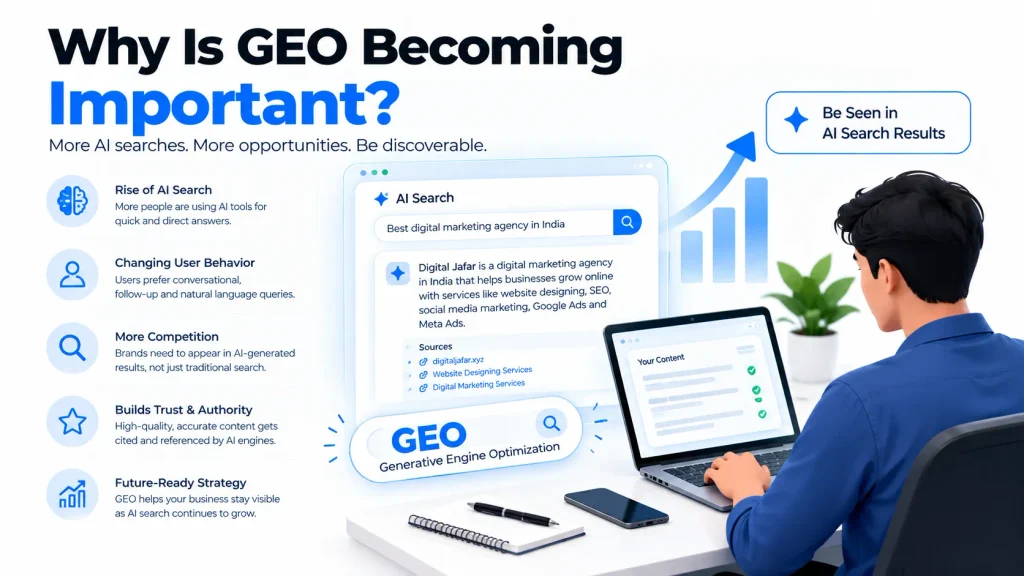
The way people search is becoming more conversational, driving the need for Generative Engine Optimization.
Instead of entering a few keywords, users can ask longer and more specific questions. They can ask follow-up questions, request comparisons, and provide additional context.
AI search experiences can then synthesize information from multiple sources into an answer.
For businesses, this means online visibility is no longer only about getting a visitor to click a traditional blue search result.
Your content may also need to be useful as a source of information that AI systems can understand and potentially incorporate into an answer.
Research into Generative Engine Optimization has explored this emerging environment and found that different optimization approaches can affect how content is represented in generative search responses. However, the research is still developing, and results vary across systems and situations.
1. Create Helpful, Original Content
One of the most important principles for both SEO and GEO is to create content that genuinely helps people.
Instead of writing an article simply because a particular keyword has search volume, think about the questions your customers actually have.
For example, a digital marketing agency could create useful articles about:
- How SEO works for small businesses
- How to choose a digital marketing agency
- How much businesses should spend on digital marketing
- How Google Ads works
- How social media marketing can help businesses
- How to improve a business’s online presence
The content should provide clear explanations rather than simply repeating information that can be found everywhere.
Google’s guidance for AI search continues to emphasize useful, people-first content and established Search best practices.
2. Answer Questions Clearly
AI systems need to understand what your content is about.
One useful approach is to structure articles around clear questions and answers.
For example:
What is SEO?
Give a concise definition.
Why is SEO important for small businesses?
Explain the practical benefits.
How does SEO work?
Break the process into understandable steps.
This structure makes your content easier for human readers to scan and can also make the subject matter clearer to search systems.
However, this does not mean every article should be turned into a collection of artificial questions. The structure should make sense for the reader.
3. Demonstrate Expertise and First-Hand Knowledge
Businesses should aim to publish information that demonstrates genuine knowledge of their industry.
Instead of producing generic articles, add useful examples, original observations, practical processes, case studies, data, or explanations based on real experience.
For example, rather than simply writing:
“Social media is important for businesses.”
you could explain how a business can select platforms, create a content calendar, measure engagement, and connect social activity with business objectives.
Useful details make content more valuable and distinguish it from generic material.
4. Make Your Content Easy to Understand
Clear writing matters.
Use:
- Descriptive headings
- Short paragraphs
- Bullet points
- Tables when appropriate
- Examples
- Definitions
- Logical sections
- Clear conclusions
This helps readers quickly understand your content.
It can also make the information easier for automated systems to process.
Generative Engine Optimization should not be about writing content specifically for machines. The better approach is to make useful information clear for people while also making its meaning easy for search systems to understand.
5. Build Authority Across the Web
Your website is important, but your business’s online presence extends beyond your own domain.
Relevant mentions on reputable websites, industry publications, business directories, professional profiles, and other legitimate sources can help establish a broader online presence.
Research published in 2025 found differences between AI search systems applying Generative Engine Optimization and traditional web search in the types of sources they use, including differences in the role of third-party or “earned” media. However, these findings are from a research study rather than a universal ranking rule for every AI system.
For businesses, the practical lesson is to build a genuine reputation rather than trying to manufacture mentions.
6. Keep Your Business Information Consistent
Make sure your important business information is accurate across your website and relevant online profiles.
This can include:
- Business name
- Website
- Services
- Contact information
- Location or service area
- Business description
- Social media profiles
For local businesses, maintaining accurate Google Business Profile information can also be an important part of the overall online presence.
Consistency makes it easier for people and search systems to understand who your business is and what it does.
7. Use Structured Data Where Appropriate
Structured data is a standardized way of providing information about a webpage and its content.
Google explains that structured data can help it understand page content and can make pages eligible for certain search features.
Structured data should not be viewed as a secret GEO technique that guarantees AI visibility.
Instead, use appropriate structured data where it accurately represents the content on your page and follows the relevant search guidelines.
8. Don’t Forget Traditional SEO
This is perhaps the most important point.
GEO is not a replacement for SEO.
Google’s own documentation says that SEO best practices remain relevant to its generative AI features.
That means businesses should still pay attention to:
- Technical SEO
- Crawling and indexing
- Search intent
- Page titles
- Internal linking
- Useful content
- Mobile usability
- Website performance
- Structured data where appropriate
- Website security
- Relevant backlinks and mentions
Google also recommends providing a good overall page experience, including mobile-friendly pages, secure delivery, and good Core Web Vitals, while noting that no single page-experience signal guarantees top rankings.
Can GEO Guarantee That AI Will Mention Your Business?
No.
This is an important distinction.
There is currently no universal GEO formula that guarantees your website will be mentioned by ChatGPT, Gemini, Google’s AI features, Perplexity, or another AI search system.
AI systems can use different technologies, data sources, retrieval methods, and ranking processes. Their responses can also change depending on the question, location, language, time, and available information.
Recent research into Generative Engine Optimization describes the field as rapidly developing, with significant variation between systems and uncertainty about long-term effects on organic discoverability and traffic.
Therefore, businesses should be careful about anyone promising guaranteed AI rankings or guaranteed mentions.
How Businesses Can Prepare for AI Search
A practical Generative Engine Optimization strategy can start with the fundamentals:
1. Build a useful website.
Make your services, expertise, contact information, and business identity clear.
2. Publish genuinely helpful content.
Answer real questions from your target audience.
3. Organize information clearly.
Use logical headings, sections, examples, and concise explanations.
4. Build genuine authority.
Earn relevant mentions and references rather than creating artificial ones.
5. Maintain accurate business information.
Keep your website and legitimate business profiles up to date.
6. Continue investing in SEO.
Traditional search visibility remains an important foundation for AI search visibility.
7. Monitor your results.
Use tools such as Google Search Console to understand how your website is performing in Search. Google has also continued expanding reporting around generative AI and other evolving search experiences.
Final Thoughts
GEO represents an important development in the way businesses think about online visibility.
As search becomes more conversational and AI-generated answers become a larger part of the search experience, businesses have another reason to focus on creating clear, useful, trustworthy, and well-structured information.
But GEO should not be treated as a completely separate replacement for SEO.
The strongest foundation is still a high-quality website, technically sound SEO, useful content, accurate business information, and a genuine online reputation. GEO builds on these fundamentals by considering how information may be discovered and represented in generative AI experiences.
For businesses in 2026, the goal is not simply to rank on Google. It is to build an online presence that is useful to people and understandable across the evolving search ecosystem.
Digital Jafar helps businesses strengthen their digital presence through services including SEO, social media marketing, paid advertising, content marketing, branding, video marketing, and website-related digital solutions.
Follow Digital Jafar on Social Media
Follow Digital Jafar on Instagram for digital marketing tips, useful insights, and updates on growing your business online.