
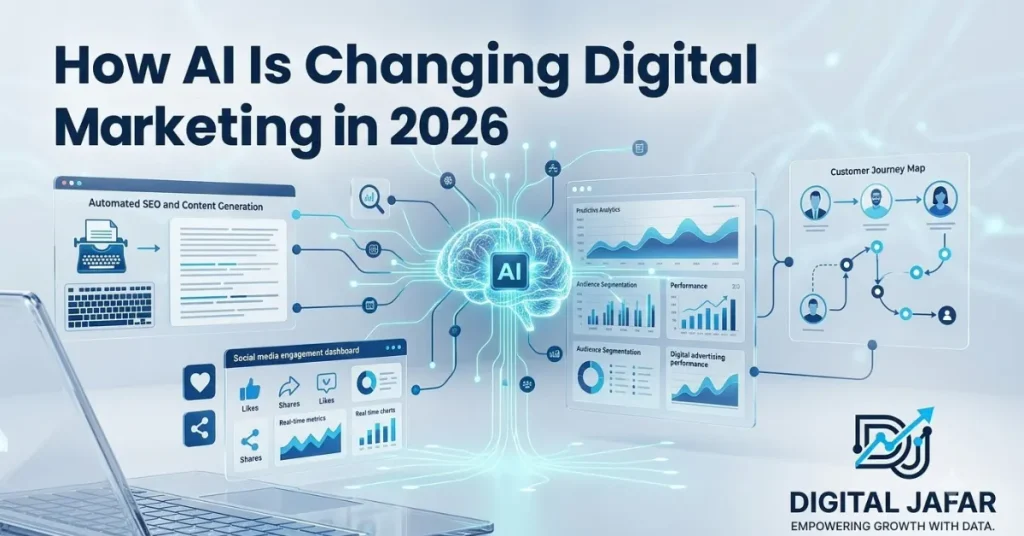
The role of AI in digital marketing has become one of the biggest changes in digital marketing in recent years. In 2026, AI is no longer something that businesses can simply treat as a future technology. It is already being used to create content, understand customers, analyze data, improve advertising campaigns, automate repetitive tasks, and make marketing decisions faster.
For businesses of all sizes, this creates new opportunities. At the same time, it also means that marketers need to understand how to use AI without losing the creativity, strategy, and human connection that make marketing effective.
So, how exactly is AI changing digital marketing in 2026? Let’s take a closer look.
1. AI Is Making Marketing More Personalized
Customers expect brands to understand their interests and provide relevant experiences. Using AI in digital marketing makes it easier for businesses to achieve this level of personalization at scale.
AI systems can analyze information such as browsing behavior, previous interactions, content engagement, and purchasing patterns. Marketers can use these insights to understand different customer groups and create more relevant campaigns.
For example, an online store can use customer behavior to recommend products that are more relevant to an individual visitor. Similarly, a digital marketing campaign can be adjusted based on the interests or behavior of different audiences.
This type of personalization can help businesses communicate with customers more effectively instead of showing the same message to everyone.
2. AI Is Changing Content Creation

Content remains an important element, but the implementation of AI in digital marketing is changing how content is produced and distributed.
AI tools can help marketers generate ideas, create outlines, write first drafts, develop social media captions, summarize information, and adapt content for different platforms. This can significantly reduce the time required for repetitive content tasks.
However, AI-generated content should not simply be published without review. Businesses still need human creativity, experience, fact-checking, brand knowledge, and editing.
The most effective approach when leveraging AI in digital marketing is often to use AI as a supporting tool rather than a complete replacement for the content team.
A marketer can use AI to generate ten content ideas in a few seconds, but deciding which idea is actually useful for the target audience still requires human judgment.
3. AI Is Transforming SEO
Search engine optimization is another area transformed by the integration of AI in digital marketing.
Traditional SEO focused heavily on ranking webpages for specific keywords. While keywords, technical SEO, useful content, backlinks, and other established practices remain important, search is becoming more conversational and AI-powered.
People are increasingly asking search engines complex questions instead of simply typing short keywords. AI-powered search experiences can provide direct answers and summaries, which means businesses need to focus on creating useful, trustworthy, well-structured content.
This has also increased interest in concepts such as Generative Engine Optimization (GEO), where businesses think about how their content can be discovered and represented in AI-generated search results.
For marketers utilizing AI in digital marketing, the goal is no longer just to include keywords. Content needs to genuinely answer questions and provide value.
4. AI Is Improving Digital Advertising
Paid advertising is another key area where the impact of AI in digital marketing is clearly evident.
Platforms such as Google and Meta use machine learning and automation to help advertisers identify audiences, optimize campaigns, test different creatives, and allocate advertising budgets.
AI can analyze large amounts of campaign data much faster than a person manually reviewing every data point. This allows marketers to identify patterns and make adjustments more efficiently.
For example, AI in Digital Marketing can help determine which type of audience is responding better to an advertisement or which creative is generating stronger engagement.
However, automation does not mean marketers should stop monitoring campaigns. Businesses still need clear objectives, appropriate targeting, strong creative ideas, budget control, and regular performance analysis.
5. AI Is Making Data Analysis Faster
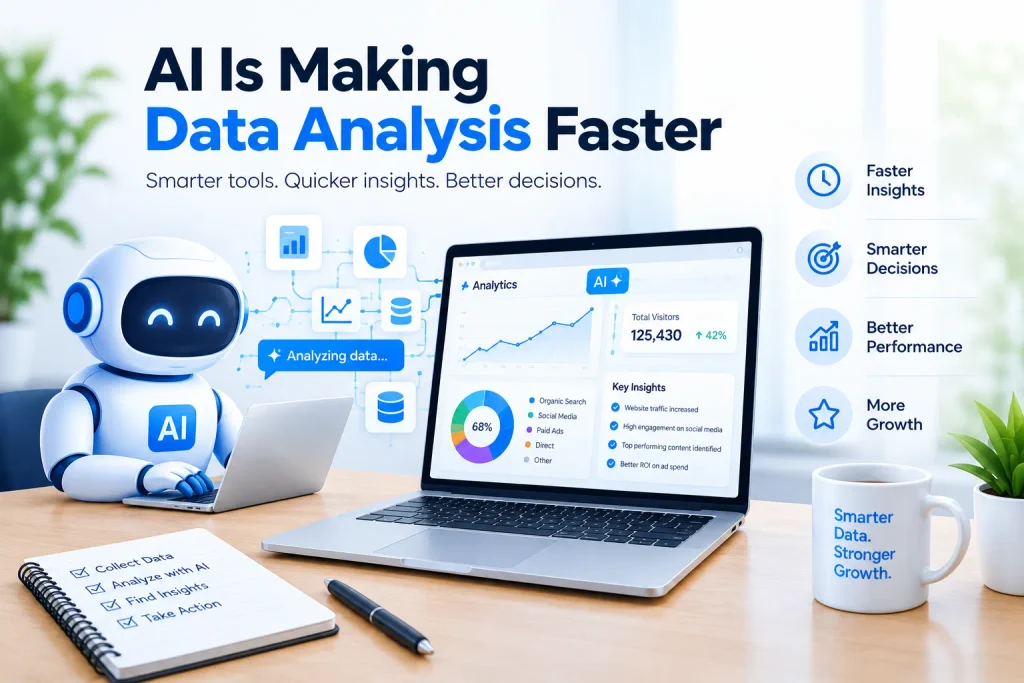
Digital marketing generates a huge amount of data.
Website visits, clicks, impressions, engagement, conversions, customer journeys, advertising performance, and social media activity can produce thousands or even millions of data points.
Leveraging AI in digital marketing can help marketers analyze this complex information much more efficiently.
Instead of manually looking through large spreadsheets, marketers can use AI-powered tools to identify trends, compare performance, summarize reports, and find unusual changes in campaign results.
This allows marketers to spend less time collecting and organizing information and more time deciding what actions should be taken.
The important point is that data itself is not enough. Businesses need to turn data into useful decisions.
6. AI Is Improving Customer Support
Customer communication is another domain where applying AI in digital marketing is proving to be immensely useful.
AI-powered chatbots and virtual assistants can answer common questions, provide basic information, help users navigate websites, and support customers outside normal business hours.
For example, a customer might ask about business hours, pricing, delivery information, or the status of a service. An AI assistant can provide an immediate response when the necessary information is available.
This can improve response times and reduce the workload associated with repetitive questions.
However, human support remains important for complex, sensitive, or unusual situations. A good customer experience often requires a combination of automation and human assistance.
7. AI Is Helping Businesses Understand Their Customers
Understanding customers has always been essential, and applying AI in digital marketing makes this process far more data-driven.
Businesses can analyze customer feedback, reviews, social media conversations, website behavior, and other available information to identify common interests, questions, and concerns.
These insights can help marketers develop better products, services, campaigns, and content.
For example, if customers repeatedly ask the same question about a service, a business could create a detailed blog article or video explaining that topic.
In this way, customer data can become a source of content and marketing ideas.
8. Short-Form Video and Creative Marketing Are Also Changing
Video content plays a major role on social platforms, and using AI in digital marketing opens new avenues for creative production.
AI can assist with different parts of the video creation process, including idea generation, scripts, captions, editing, transcription, and content repurposing.
A single long-form piece of content can potentially be turned into multiple short posts, videos, captions, or other formats with the help of AI tools.
This gives smaller businesses an opportunity to produce more content without needing a large production team.
Still, creativity matters. AI can help with production, but a strong understanding of the brand and audience is necessary to create content that people actually want to watch.
9. Human Creativity Still Matters
With all these developments surrounding AI in digital marketing, one important question remains: Will AI replace digital marketers?
AI can automate many tasks, but digital marketing involves much more than generating content or analyzing numbers.
Marketing requires understanding people, developing strategies, building brands, communicating ideas, solving problems, and making decisions based on business goals.
AI can provide suggestions and process information quickly, but humans are still responsible for deciding what should be done and why.
The future is therefore less about AI versus marketers and more about marketers using AI effectively.
10. What Businesses Should Do in 2026
To succeed with AI in digital marketing, businesses do not necessarily need to adopt every new tool they find. Instead, they should identify areas where AI can solve real problems.
Start by looking at repetitive tasks such as content research, reporting, customer FAQs, data analysis, or content repurposing.
Then introduce AI where it can save time or improve efficiency while maintaining human review.
Businesses should also pay attention to accuracy, privacy, brand consistency, originality, and transparency when using AI.
The goal should not be to use AI simply because it is popular. The goal should be to use it where it creates genuine value for the business and its customers.
Conclusion
The growth of AI in digital marketing in 2026 is making marketing strategies more data-driven, personalized, automated, and efficient. From SEO and content creation to paid advertising, customer support, analytics, and social media, AI is becoming part of many everyday marketing activities.
But successful marketing still depends on human understanding and creativity.
Businesses that learn how to combine AI technology with strong strategy, original ideas, and genuine customer understanding can adapt more effectively to the changing digital landscape.
The future of digital marketing is not simply about using more technology. It is about using technology intelligently while keeping the customer at the center of the strategy.
Digital Jafar helps businesses build and strengthen their online presence through digital marketing strategies designed around their goals, audience, and brand.
Follow Digital Jafar on Social Media
Follow Digital Jafar on Instagram for digital marketing tips, useful insights, and updates on growing your business online.